Research release / Quantum information
How often does exact quantum simulation need a larger message?
A classical simulator can reproduce quantum measurement outcomes with few bits on average. The question is how often it needs a much larger menu of possible messages.
AI-assisted research draft. The proposed proof has not been independently verified or peer reviewed.
What the paper proposes
Alice knows how a quantum state was prepared. Bob chooses a measurement. Their classical simulator must reproduce its outcome probabilities for every pair of inputs. Once their shared randomness is fixed, let L count the possible messages Alice could send as her input varies.
The manuscript proposes that for dimension d ≥ 4, the fastest attainable power-law decay of the probability that L exceeds m has exponent 1/(d − 2). The proposed simulator groups messages at each scale so that it attains this rate. For d ≥ 5, the proof uses a strong estimate on averaged measurement responses to rule out any faster exponent.
Consider dimension four. The proposed proof constructs an exact simulator for which the mean of L0.49 is finite. It also argues that in every exact simulator the mean of √L is infinite. The distinction concerns the size of the available menu, even when average communication in bits is finite.
Castellano, Sekatski and Brunner posed the optimal-exponent question after obtaining the interval from 1/6 to 1 in dimension four. Kashogi’s manuscript proposes 1/2. Read the original question in Section V.
Where the dimension-four bound comes from
De Gois, Santos and Vieira established the dimension-four averaging estimate and showed that each individual message contributes zero slope at zero overlap. Castellano, Sekatski and Brunner bounded each contribution by 8 and obtained a total bound of 8D for D labels. If one keeps the probability mass of each input cell when summing, the total bound becomes 8√D. Lemma 13 shows why this forces the mean of √L to diverge. De Gois, Santos and Vieira, Appendices B.5–B.6 · Castellano, Sekatski and Brunner, Appendix A
The matching construction is a separate step. De Gois, Santos and Vieira used random caps and a finite fallback procedure for qutrits (dimension three), with 26 binary copies in their general-measurement protocol. In dimensions four and above, Lemma 15 specifies both cap multipliers and the identity that cancels the unwanted harmonic degrees. The proposed reduction to general measurements uses one binary message per tape and preserves the tail exponent. Earlier qutrit construction, Appendix D
What the CPU runs measured
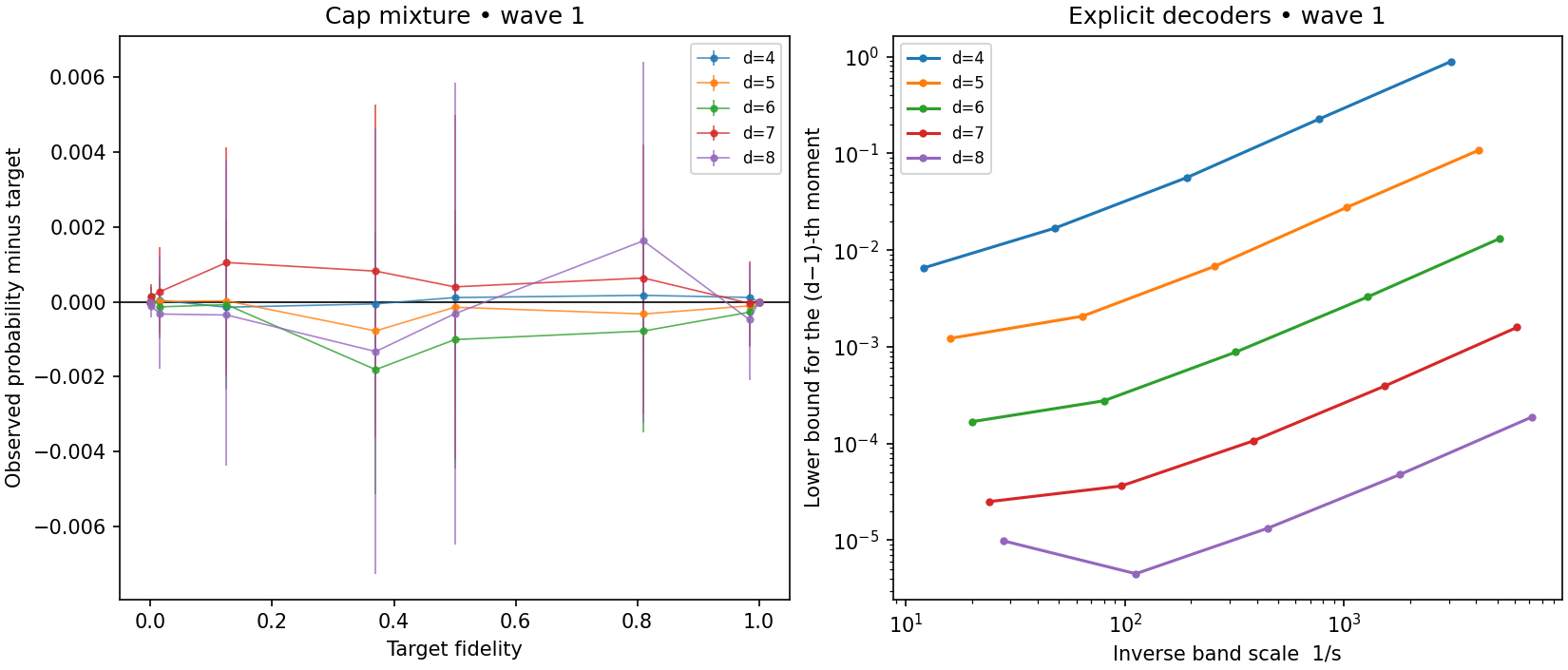
The archived runs cover 93 cases in dimensions four through eight. In the cap-mixture experiment, 6,943,070 accepted samples produced 62,487,630 binary evaluations. Nine evaluations share each sample. The largest absolute discrepancy from a target probability was 0.002195, at a target of one half in dimension seven. Inspect that raw result (JSON).
The revised exact-arithmetic test builds two twelve-outcome probability vectors on every block, one with the compensation term and one with that term omitted. At both the original scale (1/256) and the theorem’s dimension-four scale (1/128), the correct vector sums to one on all 18 blocks and reproduces all twelve Born probabilities on averaging. The faulty vector fails on six blocks at each scale. Inspect the exact totals for each block (JSON).
The optional geometric simulator uses finitely many random centres in place of the proof’s deterministic covering net. A random list can miss a cap, and counts from sampled inputs do not measure the distribution of L over complete tapes. The 93 archived CPU cases test components of the construction. A replay with the original seeds matched all 93 cell records after excluding elapsed times. Read the CPU replay log.
Reproduce the results
Release 1.4 contains the revised LaTeX manuscript, Python checks, sampling code, pinned dependencies, raw integer counts, 75 saved decoder arrays, and a checksum manifest. Extract the ZIP, open its Critical_Alphabet directory and follow README.md using Python 3.12.
python verify.py          # Check the saved results
python verify.py --full   # Generate a fresh CPU replay
- Complete research archive (ZIP)
- Read the normalization and dimension checks (Python)
- Read the general-measurement decoder checks (Python)
Archive SHA-25625c364e4e42f1af094ff783b9b15e5e38f417033f1f637c791269bb43e9e7aad